
The Infrastructural Decision Every Business Should Make Early
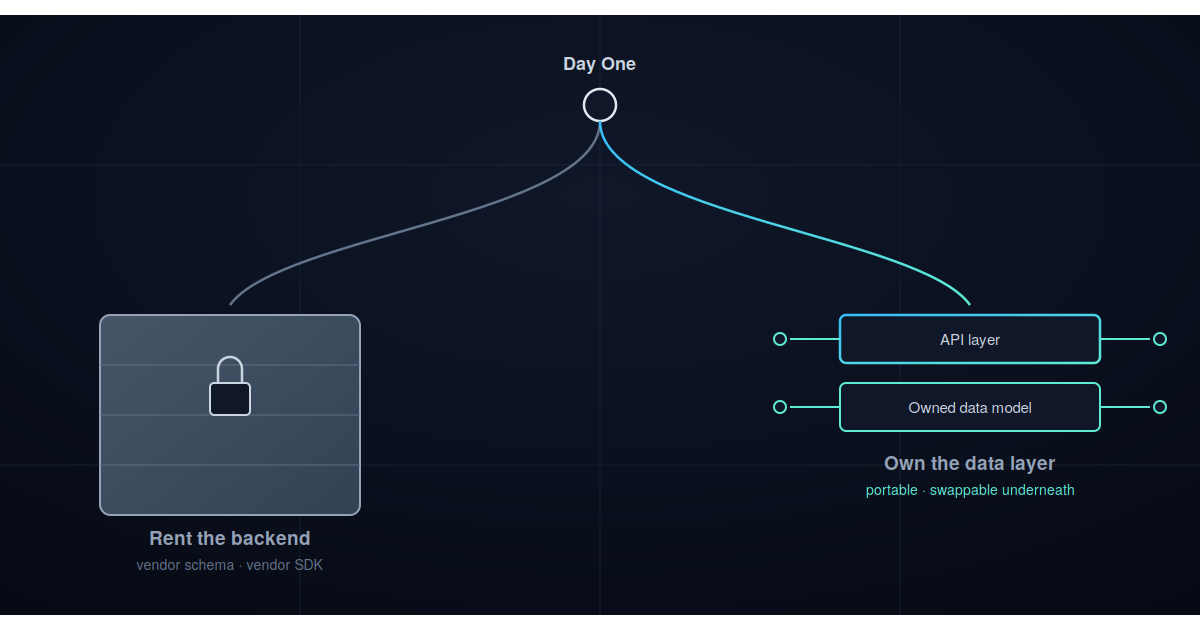
Most infrastructure decisions get made quietly, by default, in the first sprint. Someone picks a backend-as-a-service platform because it gets auth, a database, and file storage working before lunch. Nobody calls it a decision at the time. It's just the fastest way to ship.
It is a decision, though one of the few early calls that quietly shapes everything a business can and can't do three years later. And it deserves to be made on purpose.
The decision, stated plainly
Do you own your data and API layer, or do you rent it from a platform that owns it for you?
Renting looks like Firebase, Supabase, AWS Amplify, or any of the increasingly popular "compose your own backend" stacks, a database-as-a-service paired with an auth-as-a-service and a queue-as-a-service, glued together with SDKs. Owning looks like a backend you control end to end: your own schema, your own API layer, your own auth flow, deployed wherever you choose.
Neither answer is wrong on its own. What's wrong is not realizing a decision is being made at all.
Why this one compounds differently than most tech choices
Most tooling choices are reversible with effort. This one usually isn't, and the reason is structural rather than emotional: your data ends up living in the vendor's schema, your auth flows run through their SDK, and a meaningful share of your business logic ends up inside their function runtime. Migrating off a backend-as-a-service platform later tends to look less like swapping a library and more like rebuilding the backend from scratch except now there's a live product and real users depending on the old one while you do it.
Vendor lock-in research from across the industry this year converges on the same pattern: it rarely shows up as one dramatic event. It accumulates quietly through pricing tiers that jump hard at scale, proprietary features that don't transfer to any other platform, and configurations only the vendor's own consultants fully understand. By the time it's visible on an invoice, it's already been shaping decisions for a year.
None of this is a knock on any specific platform. It's a description of what renting your core infrastructure actually costs, even when the sticker price says otherwise.
When renting is the right call
This isn't an argument for building everything from scratch on day one. Renting the backend is often exactly right early on: validating an idea, building a prototype, getting a small team from blank repo to working product in an afternoon. At that stage, speed legitimately matters more than ownership.
The signals that it's time to revisit the decision tend to show up together: pricing that no longer scales sensibly with usage, a team with the capacity to actually operate its own backend, a need to control the data model precisely for compliance or integration reasons, or a feature roadmap that keeps running into the platform's walls. None of these show up on day one. All of them eventually show up for any business that grows past its first version.
The migration path, if you wait too long
Businesses that do need to leave a rented backend rarely do it in one move, and for good reason a full cutover with live users underneath it is its own kind of risk. The pattern that tends to work is closer to a gradual replacement: stand up an owned backend in parallel, point new features at it first, migrate existing features over one at a time, and only retire the old platform once nothing depends on it anymore. The data model is almost always the hard part, not the application code sitting on top of it.
It's a workable path. It's also considerably more expensive, in time and engineering attention, than making the ownership decision earlier would have been.
What owning the data layer actually looks like
In practice, owning your infrastructure isn't about avoiding every managed service it's about controlling the layer that everything else depends on:
A relational data model you control, managed through your own schema and an ORM like Prisma or Drizzle, rather than a vendor-specific data format you'd have to translate on the way out.
An API layer as the seam, so your business logic talks to a contract you defined, not directly to a vendor's SDK. If the provider behind that contract ever needs to change, the seam absorbs the change instead of your whole codebase.
Auth as a defined component, not something buried inside a platform's function runtime where it's hard to separate later.
Deployment choices made knowingly proprietary platform features can be genuinely useful, but it's worth knowing in advance which ones don't transfer cleanly elsewhere if you ever need to move.
This is the same architectural posture that makes a system easier to harden, easier to scale, and increasingly relevant this year easier to safely connect to AI agents that need stable, well-documented APIs rather than a vendor's internal schema to act through.
Where we land on this
Across the systems we build for fintech platforms processing real transactions, for insurance and NGO platforms handling sensitive records, we consistently choose to build the data and API layer ourselves: PostgreSQL under our control, a defined API contract in front of it, no backend-as-a-service standing between a client and their own data. It costs more upfront than wiring up a managed platform. It's also the reason those systems can grow, integrate, and adapt for years without an expensive rebuild waiting at the other end.
The fastest way to start isn't always the cheapest way to grow. That's the decision worth making deliberately, before it gets made for you by default.
Nova X Solutions builds owned, API-first backend architecture, Mobile Apps, Custom Software Solutions, systems designed for control and longevity, not vendor lock-in. Learn more at novaxhq.com.
Keep reading
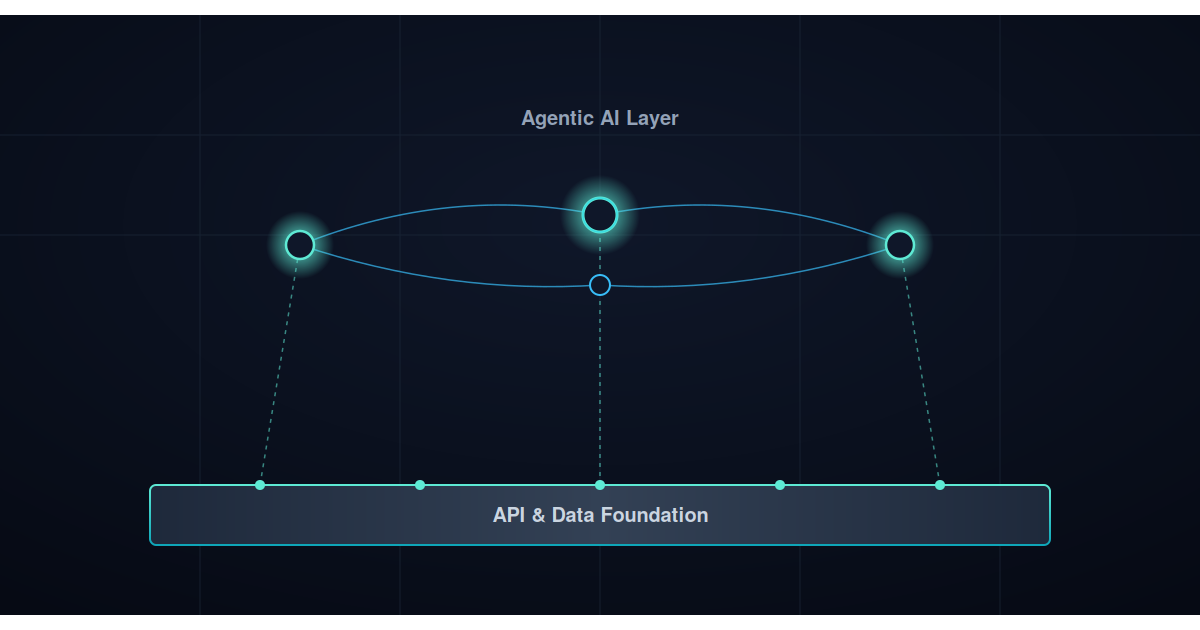
The Agentic AI Gap: Why the Infrastructure Matters More Than the Model
Agentic AI adoption is surging globally and across Nigeria, but most enterprise systems aren't built to use it. Here's what actually needs to come first.
Read article
Building Systems That Hold Under Pressure
How Nova X Solutions architects resilient fintech, insurance, and NGO platforms that hold up under real-world load, failure, and scale.
Read article